


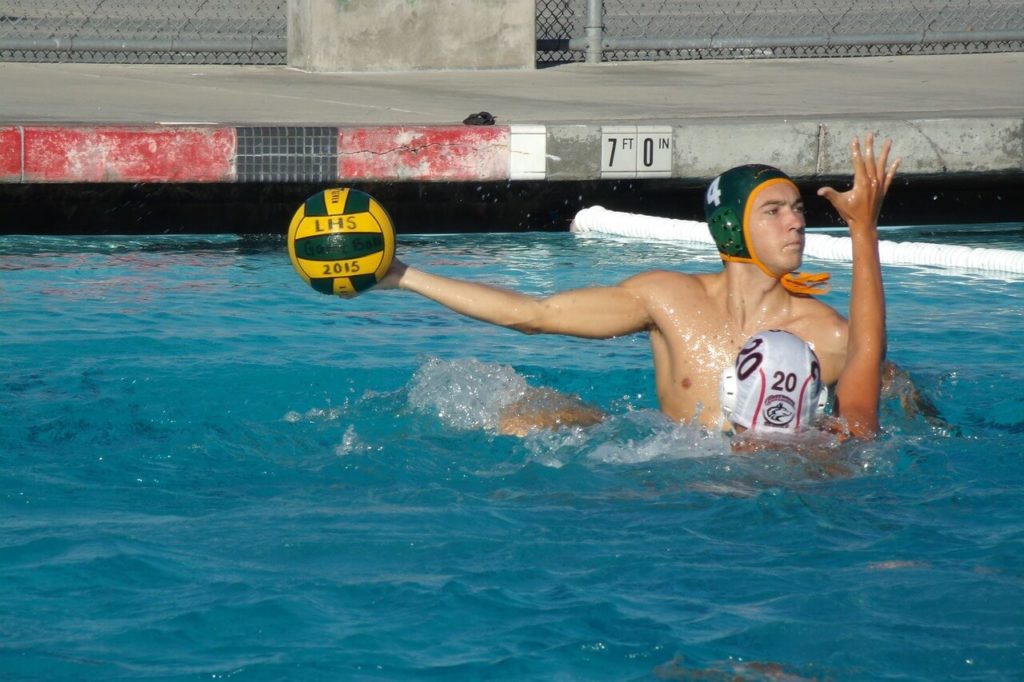
Water polo, an advent of the late 19th century, provides a whole host of benefits for the player, from strategy and team building skills to a full body workout. While first played in Great Britain, the game has spread throughout the world and is featured in the Summer Olympics, Commonwealth Games, Mediterranean Games, and more.
The game was established sometime in the 19th century, according to the Collegiate Water Polo Association, and was designed to be a form of water rugby. Originally played with a pig’s stomach, a rubber ball was introduced around 1870, the same time the London Swimming Club drew up official rules and hosted their first match at the Crystal Palace Plunge in London.
William Wilson, an English swimming instructor and journalist, drew up his own set of rules and called the game aquatic football. The first game under his auspicious was held in Aberdeen, Scotland. In 1885 the Swimming Association of Great Britain expanded Wilson’s rules and they served as the basis for those used in contemporary games. Wilson is also noted for being the first journalist to cover swimming as a sport.
In the first decades of the sport, matches often took place in rivers and lakes or pools with poor or no filtration systems. The dirtiness of the water added an extra element to the game, as it made seeing the ball and determining which player possessed it rather difficult.
Throughout the last quarter of the 19th century, advents were made to the game, including more standardized rules, an increase in the size of the game ball, and the creation of national styles of the game. In 1900, water polo became the first team sport at the Olympics, though a women’s team wasn’t added until 2000. At the most recent games, Serbia won the gold in the men’s competition, while the United States received gold in the women’s match.


Key Elements of Gameplay
A standard match of water polo consists of four quarters and two teams of seven players. Each team has six field players and one goalkeeper, with reserve players available to fill in if needed. Modern game play typically takes place in an uniformly 7 foot deep pool. Players wear numbered and colored bathing caps. The game ball and goals are both designed to float in the water.
Players typically employ a special form of treading water know as eggbeater kicking. This unique method of swimming consists of alternating one-legged breaststroke kicks. Eggbeater kicking enables the swimmer to keep his hands free, thus permitting handling of the ball and to also remain stable and afloat in the water.
The field players, the six members of the team who are responsible for scoring goals and also keeping the ball away from their own goal, are required to throw, catch, and manipulate the ball with only one hand. However, the goalkeeper is permitted to use both hands to defend the goal from the opposing team. Just like in basketball, the movement of the ball in front of a player is called dribbling.
The goalkeeper is charged with protecting their team’s goal from a ball projected by the other team. As long as the goalkeeper remains within the five meter area in front of his goal he has the ability to perform certain actions other players are not permitted to do. He can punch the ball with a clenched fist, use both hands to handle the ball, and also touch the bottom of the pool.


Water polo is very much a contact sport, so fouls are often ruled. Two types of fouls are found in the game. A minor foul includes such actions as touching the ball with two hands, holding it under water, wasting time, or walking on or pushing off the bottom of the pool. The penalty for a minor foul is to give the opposing team a free throw. A major foul will cause the player who commits the infraction to be excluded from the game for 20 seconds or removed from the game entirely, and possibly from future games depending upon the severity of the infraction. A common major foul is committed when a player holds or strikes a player who is not in possession of the ball or purposefully splashes water in another players face; either of these actions will result in a simple 20 second exclusion. More serious major fouls include physical violence or disrespect and often result in the removal of the offending player and a substitute player being introduced after 20 seconds. More nuanced penalties can be assessed in rare instances of the demonstration of a serious lack of sportsmanship.
A Powerful Key to Physical Fitness
For those who are seeking a sport to increase stamina and build strength, water polo is a prime choice. Water polo involves movement and exercise that will naturally boost energy and control weight as well.
The constant movement of water polo players, since rules prevent touching the bottom of the pool, provides a workout for nearly every muscle in the body, the most obvious being the legs. Passing the ball or shifting directions in the water trains the abdomen and back, and swimming from one end to the other increases the strength of the arms, back, and shoulders. The added resistance found in any sport played in the water adds an extra layer to strength building not found in most land games.
USA Water Polo, which is the governing body of water polo in the United States, has concluded that playing one hour of water polo burns up to 700 calories and a full game can cause a player to swim up to four miles. The fact that the entire game is played in the water eases stress on joints, due to the water acting as a cushion. Thus, many of the stress injuries to joints or muscles found in other sports aren’t a concern in water polo. Clearly these benefits make great strides in the support of a healthy lifestyle.
Pastime of Many Well Known Names
Water polo maintains a strong following around the world and has counted a number of celebrities as players. Prince William, second in line to the British throne, played competitively while at the University of St. Andrews. Musician Sean Paul held a spot on the Jamaican national team. Other players have included Greek shipping tycoon Aristotle Onassis, Sir Alexander Fleming, who discovered Penicillin, writer Ernest Hemingway, and Hawaiian royal Duke Paoa Kahanamoku, who was also a noted surfer.


Ongoing Competitions
With the conclusion of the 2016 Summer Olympics, Hungary holds the most gold medal wins in men’s water polo since its introduction in 1900 with nine won. Serbia and Great Britain are tied for second with four and Italy has won three. Women’s water polo, not introduced until 2000, sees the United States with the most gold medals at two and Italy, Australia, and the Netherlands tied with one gold apiece.
The World Aquatics Championships of water polo, another major competition for those engaged in the sport, begun in 1973 for men and 1986 for women and now occurs every two years. Medals are awarded in the same fashion as the Olympics, gold, silver, and bronze. Currently, Serbia holds the most gold wins, followed by Hungary and Italy for men. In the women’s category the United States holds the most golds, followed by Hungary and Italy.
Other competitions are held around the world and feature teams of male players and female players of the sport.
Now entering its third century of activity, water polo has a rich history as a competitive sport enjoyed by players around the world. Royal and non-royal, famous and not, school age and older, thousands of people engage in the pastime every year. Not only does the game offer a wonderful outlet for pursuing physical fitness, but it also requires the players to work as a team and demonstrate key elements of good sportsmanship. With the following found on nearly every continent, water polo is sure to enjoy a long lifetime as a premier competitive sport.